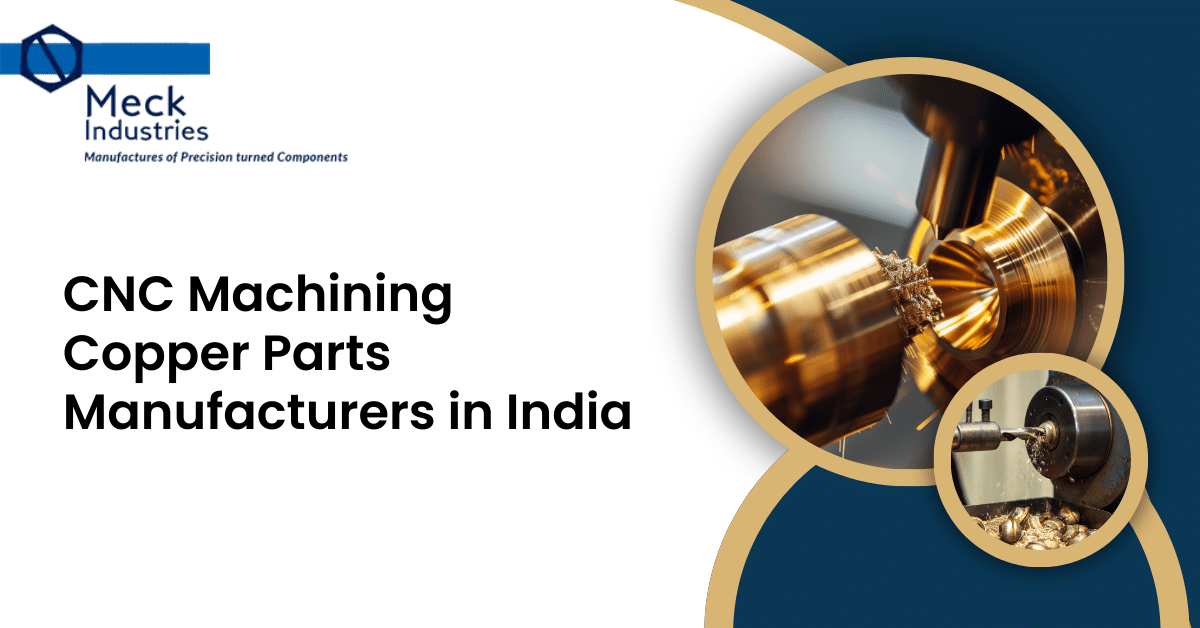

Modern manufacturing demands exceptional accuracy, faster production, and consistent quality. This is exactly where Precision CNC Machining has transformed the industry. From aerospace components to medical devices and industrial machinery, CNC machining enables manufacturers to produce complex parts with extremely tight tolerances and repeatable accuracy.
Table of Contents
Whether you’re developing prototypes or manufacturing thousands of production components, CNC machining delivers reliability, efficiency, and superior surface finishes.
In this guide, we’ll explain everything you need to know about precision CNC machining, including its working process, advantages, materials, applications, and why Meck Industries is the trusted partner for custom CNC machining solutions.
What is Precision CNC Machining?
Precision CNC Machining is a computer-controlled manufacturing process that removes material from a solid workpiece using highly accurate cutting tools.
CNC stands for Computer Numerical Control, where software controls every movement of the machine through programmed instructions called G-Code.
Unlike conventional machining, CNC systems can manufacture highly detailed components repeatedly with minimal variation, making them ideal for industries where accuracy is critical.
How Precision CNC Machining Works
Step 1: CAD Design
Every CNC project begins with a 3D model designed using Computer-Aided Design (CAD) software.
The design includes:
- Product dimensions
- Material specifications
- Hole locations
- Surface finish
- Manufacturing tolerances
Once finalized, the CAD file is transferred for manufacturing.
Step 2: CAM Programming
The CAD file is imported into Computer-Aided Manufacturing (CAM) software.
CAM software converts the design into machine instructions called:
- G-Code
- M-Code
These instructions control:
- Tool movement
- Cutting speed
- Feed rate
- Tool changes
- Spindle speed
- Machining sequence
Step 3: Machine Setup
Before machining starts, technicians prepare the CNC machine by:
- Loading the raw material
- Installing cutting tools
- Setting work coordinates
- Calibrating the machine
- Performing simulation checks
Proper setup ensures maximum precision and minimizes production errors.
Step 4: CNC Machining Process
The CNC machine automatically removes material according to the programmed instructions.
Common machining operations include:
CNC Milling
Rotating cutting tools remove material to create complex shapes and flat surfaces.
Applications include:
- Machine components
- Mold parts
- Fixtures
- Housings
CNC Turning
The workpiece rotates while the cutting tool remains stationary.
Ideal for manufacturing:
- Shafts
- Bushings
- Pins
- Sleeves
- Cylindrical parts
Drilling
High-speed drill bits create accurate holes with consistent positioning.
Tapping
Threads are cut automatically for bolts and fasteners.
Surface Finishing
Additional machining improves surface quality and dimensional accuracy.
Step 5: Inspection & Quality Control
Every finished component undergoes strict inspection to verify:
- Dimensions
- Tolerances
- Surface finish
- Material quality
- Overall accuracy
Only components meeting quality standards move to dispatch.
Materials Used in CNC Machining
Modern CNC machines can process a wide range of engineering materials.
Metals
- Aluminum
- Brass
- Copper
- Stainless Steel
- Mild Steel
- Titanium
These materials offer excellent strength, durability, and machinability.
Plastics
Common engineering plastics include:
- ABS
- Nylon
- Delrin
- Polycarbonate
- PEEK
These materials are ideal for lightweight and corrosion-resistant applications.
Industries That Use CNC Machining
Precision CNC machining is widely used in:
- Automotive Industry
- Aerospace Industry
- Medical Equipment Manufacturing
- Electronics Industry
- Industrial Machinery
- Robotics
- Defense Manufacturing
- Energy Sector
Benefits of Precision CNC Machining
High Accuracy
Modern CNC machines produce components with extremely tight tolerances.
Consistent Production
Every part is manufactured exactly like the previous one.
Faster Manufacturing
Automation reduces production time and improves efficiency.
Reduced Material Waste
Optimized machining paths minimize material loss.
Complex Part Manufacturing
CNC technology easily produces intricate designs that manual machining cannot achieve.
Excellent Surface Finish
Precision tooling creates smooth surfaces requiring minimal post-processing.
CNC Machining vs Conventional Machining
| Feature | CNC Machining | Conventional Machining |
| Accuracy | Excellent | Moderate |
| Automation | Fully Automated | Manual |
| Production Speed | High | Low |
| Repeatability | Excellent | Limited |
| Human Error | Very Low | High |
| Complex Designs | Easy | Difficult |
Factors Affecting CNC Machining Quality
Several factors influence machining quality:
- Material selection
- Machine calibration
- Tool quality
- Programming accuracy
- Cutting speed
- Feed rate
- Cooling system
- Operator expertise
Choosing an experienced CNC machining company ensures these factors are properly controlled.
Why Choose Meck Industries?
At Meck Industries, we provide reliable Precision CNC Machining Services for industries requiring high-quality machined components.
Our capabilities include:
- Precision CNC Milling
- CNC Turning
- Custom CNC Parts
- Prototype Development
- Production Machining
- Precision Engineering
- Tight Tolerance Manufacturing
- Quality Inspection
- Fast Delivery
We manufacture components using premium-grade Aluminum, Brass, Copper, Stainless Steel, Mild Steel, and Engineering Plastics, ensuring every product meets international quality standards.
With advanced CNC equipment, experienced engineers, and a strong commitment to quality, Meck Industries delivers precision-engineered solutions tailored to your manufacturing needs.
Frequently Asked Questions (FAQs)
What is Precision CNC Machining?
Precision CNC machining is a computer-controlled manufacturing process used to produce highly accurate and repeatable components from various engineering materials.
Which industries use CNC machining?
CNC machining is used in automotive, aerospace, medical, electronics, robotics, defense, industrial machinery, and energy industries.
Which materials can be machined?
Common materials include aluminum, brass, copper, stainless steel, mild steel, titanium, ABS, nylon, Delrin, and PEEK.
How accurate are CNC machines?
Modern CNC machines can achieve tolerances as tight as ±0.005 mm, depending on the machine, tooling, and material.
Can CNC machining be used for prototype development?
Yes. CNC machining is widely used for rapid prototyping because it produces production-quality components with excellent dimensional accuracy.
Why choose CNC machining over manual machining?
CNC machining offers higher precision, better repeatability, faster production, lower error rates, and the ability to manufacture complex parts consistently.
Precision CNC machining has become the foundation of modern manufacturing by delivering unmatched accuracy, consistency, and efficiency. Whether producing prototypes or large-scale production parts, CNC technology ensures exceptional quality while reducing manufacturing time and costs.
At Meck Industries, we combine advanced CNC technology with engineering expertise to manufacture precision components that meet the highest industry standards. If you’re looking for dependable CNC machining services, our team is ready to deliver customized solutions tailored to your project requirements.
Range of Products